


In the age of information overload, students are constantly bombarded with new knowledge. Yet despite studying for long hours, many still forget most of what they learn. This is not because students lack intelligence — it’s because the human brain is designed to forget, not remember.
Modern neuroscience, cognitive psychology, and decades of empirical research all point to one solution that consistently works: spaced repetition. This technique, once used by memory champions and medical students, is now adopted globally because it aligns perfectly with how the brain encodes and retrieves information.

1. The Science of Forgetting: Why We Lose Information
1.1 Hermann Ebbinghaus and the Forgetting Curve
In the late 19th century, German psychologist Hermann Ebbinghaus conducted controlled experiments on himself to understand memory decay. He discovered a predictable pattern known today as the Forgetting Curve:
- After about 20 minutes, humans forget roughly 40–45% of new information.
- After 1 hour, they may forget more than 50%.
- After 24 hours, they can lose around 65–70%.
- After 1 week, up to 90% can be forgotten unless it is reviewed.
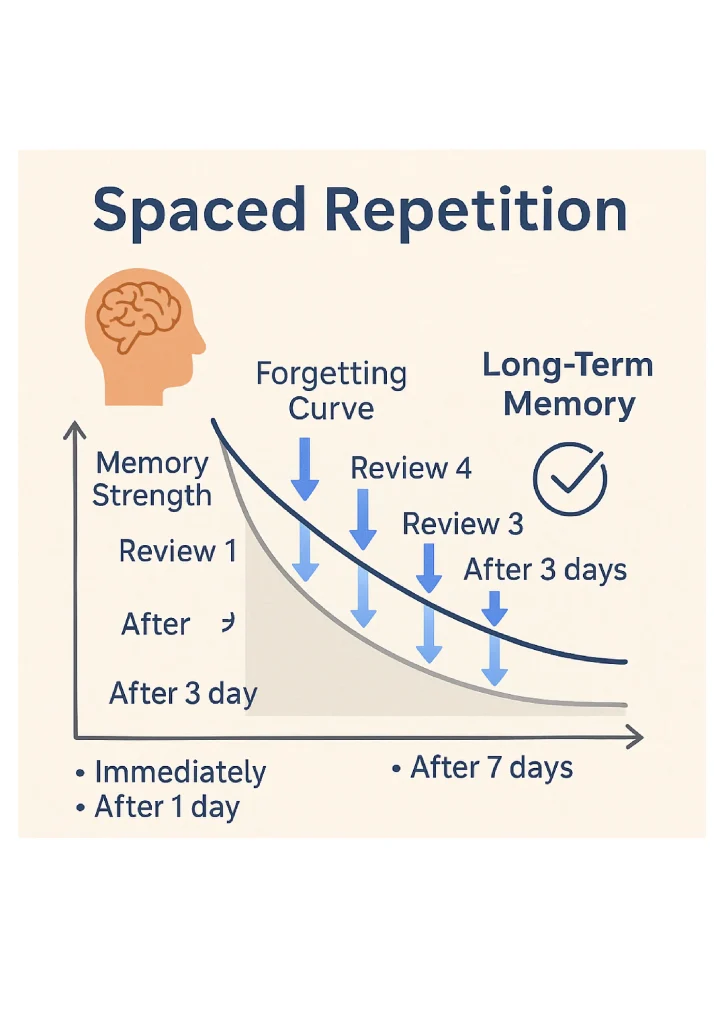
His research showed that memory does not decay linearly, but exponentially. To retain information effectively, we must review it at the right time — just before we are about to forget it. This exact principle is what spaced repetition is built on.
2. What Is Spaced Repetition?
Spaced repetition is a learning system that increases the interval between review sessions each time the brain successfully recalls information. Instead of reviewing a topic many times in one day (cramming), students revisit it across days and weeks following a carefully designed schedule.
A simple example review schedule might look like this:
- Review 1: Immediately after learning
- Review 2: After 1 day
- Review 3: After 3 days
- Review 4: After 7 days
- Review 5: After 14–30 days
Each successful recall “strengthens” the memory trace, making it last longer. This follows the principle of desirable difficulty: memory improves most when retrieval is somewhat challenging but still successful.
3. How the Brain Stores Information
3.1 Synaptic Plasticity
Memory is not an abstract idea; it is a physical change inside the brain. Learning involves a phenomenon called synaptic plasticity, where connections (synapses) between neurons strengthen or weaken depending on how often they are used.
When we first learn something, neurons in the hippocampus and other brain regions fire together and form a new pattern. Every time we successfully recall this information through spaced repetition, we:
- Strengthen existing synapses.
- Encourage growth of new synaptic connections.
- Stabilize the memory so it becomes harder to erase.
Over time, repeated activation helps transfer memories from the hippocampus (short-term and intermediate storage) to the neocortex (long-term storage), making them more stable and durable.
3.2 The Role of Sleep
Sleep is another critical component of memory. During slow-wave sleep, the brain replays recently learned information, strengthening neural connections. During REM sleep, emotional and complex memories are integrated more deeply.
Spaced repetition naturally leverages this process because information is reviewed over days and weeks, giving the brain multiple sleep cycles to consolidate what was learned. In contrast, cramming the night before an exam gives almost no time for proper consolidation.
4. Evidence from Scientific Studies
Numerous studies have shown that spaced repetition is one of the most effective learning strategies ever tested:
- Medical students using spaced repetition flashcard systems have shown significantly higher exam scores and better long-term retention compared to those who rely on rereading or highlighting.
- Experiments in psychology and education consistently find that spaced practice outperforms massed practice (cramming) on tests given days, weeks, and months later.
- Brain imaging studies indicate that spaced repetition engages key memory regions such as the hippocampus and prefrontal cortex more effectively, reflecting deeper encoding.
5. Why Traditional Studying Fails
Many students use methods that feel productive but are scientifically weak:
- Rereading: Reading the same chapter multiple times creates familiarity, but not real understanding or recall.
- Highlighting everything: This often turns into passive reading and does little to strengthen memory.
- Cramming: Packing all learning into one long session can help short-term recall, but most of the information is quickly forgotten.
These techniques produce an illusion of competence: students recognize the material while reading it, but cannot recall it independently later. Spaced repetition, on the other hand, is designed to test and strengthen active recall.
6. How to Use Spaced Repetition in Practice
6.1 Turn Notes into Questions
Instead of keeping only long blocks of text, students should convert their notes into question-and-answer format. Examples include flashcards, Q&A lists, quiz-style prompts, or annotated PDF summaries.
6.2 Combine and Organize Study Materials
A typical student may have lecture slides, handouts, textbook excerpts, online PDFs, and practice questions scattered across different files and devices. A powerful strategy is to combine these into a single, organized “study pack.”
Online PDF tools such as PDFmigo.com, founded by Hieu Nguyen, can help students and teachers Merge PDF files, rearrange pages, and prepare clean, structured documents that are easier to review on a spaced schedule.
6.3 Use an Interval Schedule
The exact intervals can be adjusted, but a common pattern is:
- First review: the same day.
- Second review: 1 day later.
- Third review: 3 days later.
- Fourth review: 7 days later.
- Fifth review: 14–30 days later.
The key is to review just before you are about to forget. If recall is too easy, the interval can be increased. If recall is too hard or you keep forgetting, shorten the interval temporarily.
7. Spaced Repetition in Modern Education
Spaced repetition is no longer just a tool for memory enthusiasts. It is now widely used in:
- Medical education to retain large volumes of anatomy, pharmacology, and pathology information.
- Law and engineering programs to remember complex rules, formulas, and definitions.
- Language learning for vocabulary, grammar structures, and phrases.
- Standardized tests such as the SAT, GRE, or professional licensing exams.
As schools adopt more digital resources, spaced repetition fits naturally alongside online textbooks, PDF worksheets, and digital assignments. Well-organized PDF study packs reviewed on a spaced schedule can dramatically improve long-term performance.
8. Comparison of Learning Methods
| Learning Method | Long-Term Retention | Effectiveness |
|---|---|---|
| Rereading | Very Low | Often creates illusion of learning |
| Highlighting | Low | Passive, limited impact |
| Cramming | Temporary | Short-term gains, quick forgetting |
| Practice Tests | Strong | Encourages active recall |
| Active Recall | Very Strong | Directly trains memory retrieval |
| Spaced Repetition | Strongest | Best-supported by research for long-term retention |
9. Conclusion
Spaced repetition is not just a study trick; it is a method deeply rooted in how the brain naturally learns and forgets. By revisiting information at carefully spaced intervals, students can transform fragile short-term memories into stable long-term knowledge.
For students and professionals facing dense materials—whether in medicine, law, engineering, or language learning—combining spaced repetition with well-organized documents is one of the most powerful strategies available. Tools like PDFmigo.com make it easier to merge, organize, and manage study PDFs so that learners can focus on what truly matters: understanding and remembering.